Looking for Duolingo questions, If you are an English language trainer, you probably know Duolingo. The company has launched its English proficiency test in 2017. Duolingo English test is around for three years now, but because of the ongoing COVID 19 pandemic, its demand has increased significantly. The test is now accepted by hundreds of Universities around the world. The main upside of this test is that you can take the test from the comfort of your home anytime. The student doesn’t need to book a test for a specific date. It costs only 49$, which is very cheap as compared to other proficiency tests.
Things to Know about the DET and Duolingo questions
Test takers can only take the test alone in a quiet environment. The Duolingo English Test can be taken in the Chrome and Opera browsers worldwide. In China, the test can be taken on the 360 and QQ browsers as well. An internet connection with at least 2 Mbps download speed and 1 Mbps upload speed is recommended for test sessions.
Before the test starts, there is an onboarding process, it checks takers computer’s microphone and speaker. During this process, the identification of the test taker is validated and the taker is informed about test rules.
There are rules for the test takers’ internet browsers. The browsers are locked down after onboarding, which means that any navigation away from the browser window will invalidate the test session. Any browser extension or plugin should also be disabled. Apart from all the above rules, the test has to abide by the rules below too:
• Interacting with anyone
• Allowing other people in the room
• Using headphones or earbuds
• Disabling the microphone or camera
• Looking off-screen
• Moving out of the frame of the camera
• Accessing any outside material or devices
• Leaving the web browser
Duolingo English Test Question types (Item description)
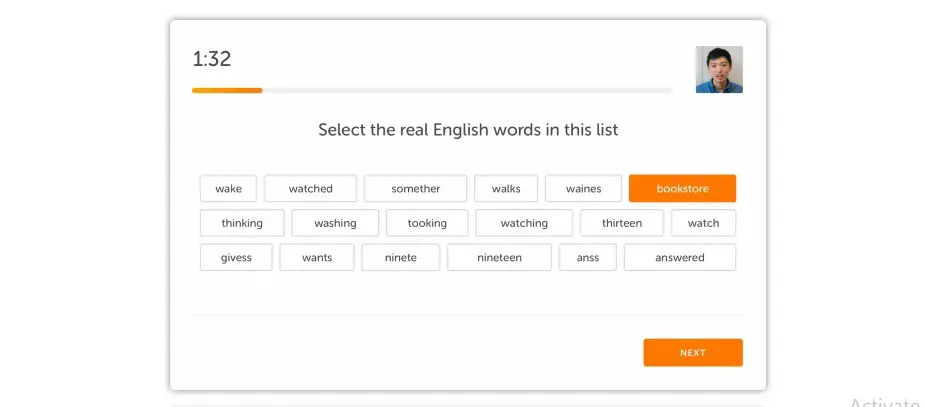
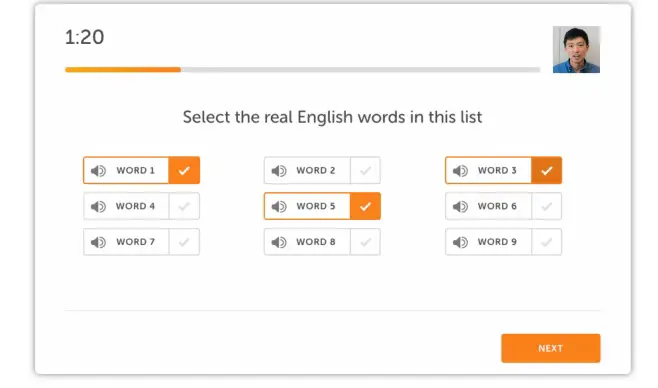
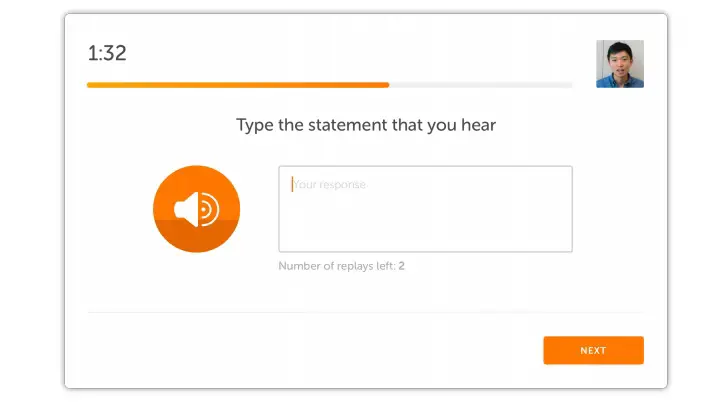
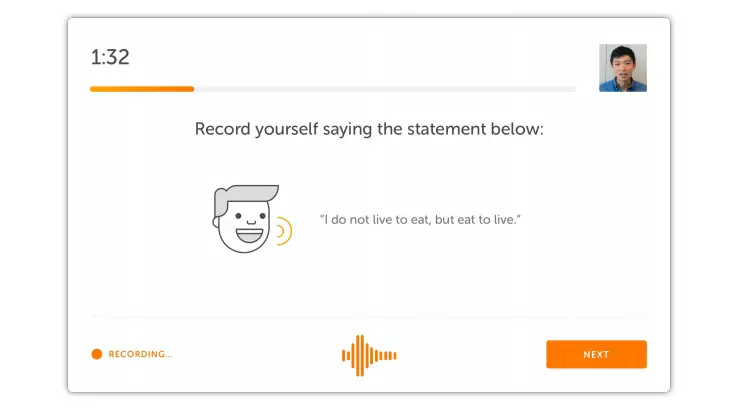
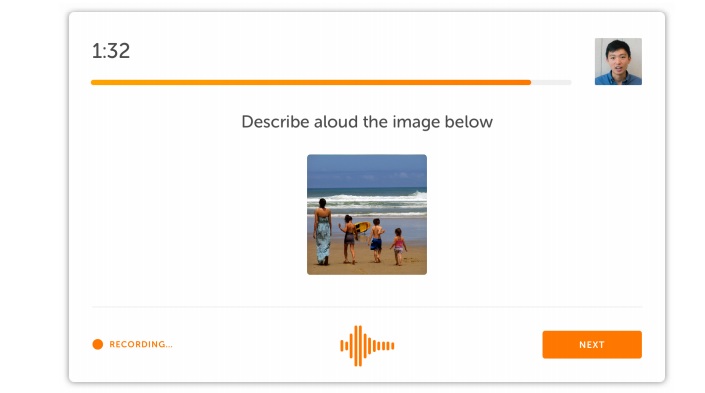
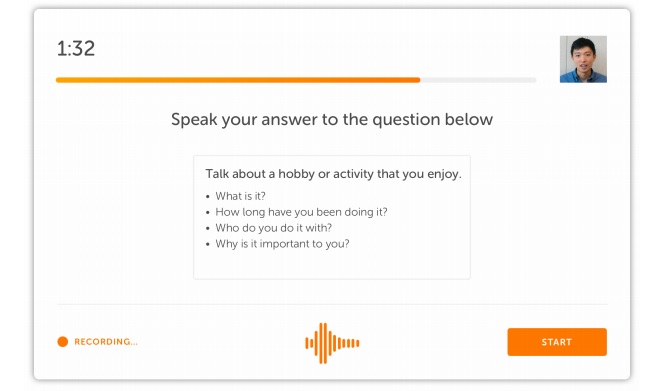
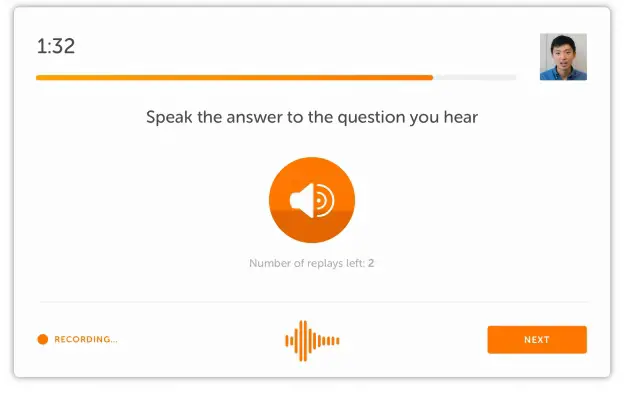
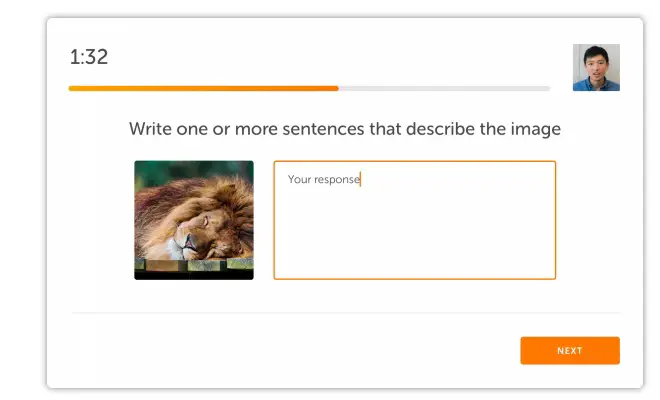
The test has seven different item types, which collectively tap into test-takers’ reading, writing, listening, and speaking abilities. Because the Duolingo English Test is a CAT, it will adjust in difficulty as the computer updates its real-time estimate of test-takers’ language proficiency as they progress through the test. There are five item types in the computer-adaptive portion of the test. The CAT item types include c-test, audio yes/no vocabulary, visual yes/no vocabulary, dictation, and elicited imitation. During each administration of the Duolingo English Test, a test taker will see at minimum three of each CAT item type and a maximum of seven of each CAT item type. The median rate of occurrence of the CAT item types across all administrations is six times per test administration. Additionally, test takers respond to four writing prompts and three speaking prompts. They are not a part of the computer-adaptive portion of the test.
However, the writing and speaking prompt also vary in difficulty, and their selection is based on the CAT’s estimate of test-taker ability. These items work together to measure test takers’ English language proficiency in reading, writing, listening and speaking.
Duolingo questions C-test
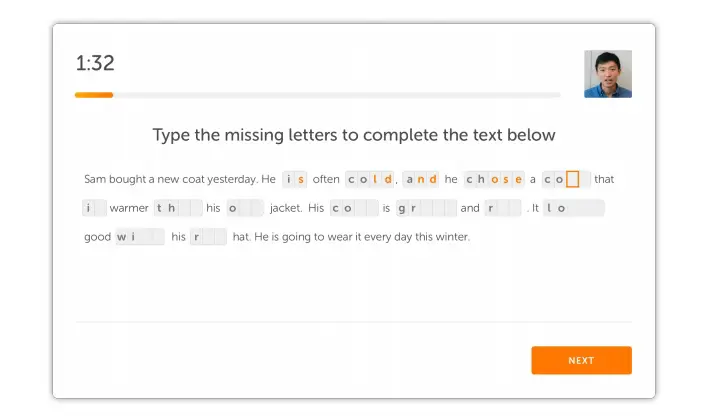
- The c-tests provide a measure of the test-takers’ reading ability. In this task, the first and last sentences are fully intact, while words in the intervening sentences are “damaged” by deleting the second half of the word. Test takers respond to the c-test items by completing the damaged words in the paragraph. The test taker needs to rely on context and discourse information to reconstruct the damaged words (which span multiple vocabulary and morpho-syntactic categories). It has been shown that c-tests are significantly correlated with many other major language proficiency tests, and additionally are related to spelling skills.